
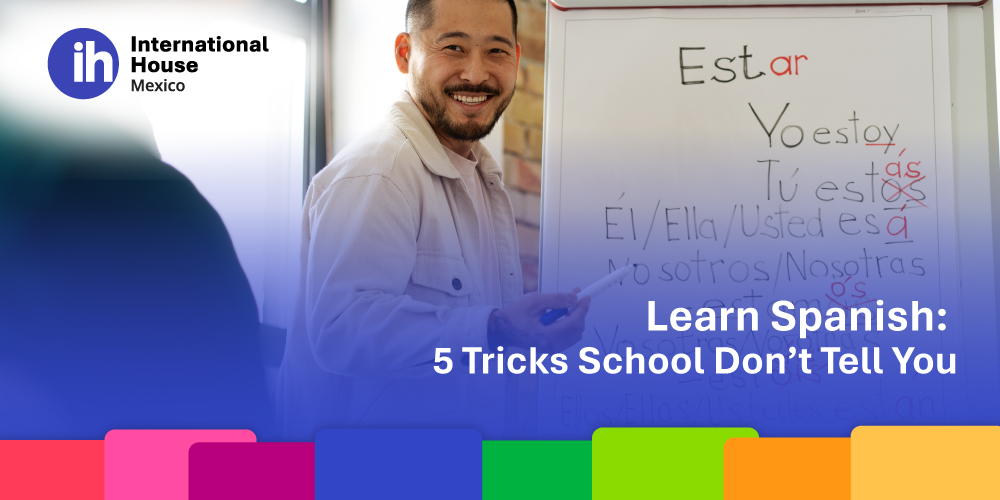
Many people want to learn Spanish fast, so they enroll in courses expecting rapid progress; however, traditional classrooms often overlook key strategies for speed. Although textbooks provide essential structure, true fluency requires more than just grammar drills. If your goal is to learn Spanish fast, you must adopt methods that go beyond the textbook. These “tricks” are not shortcuts, but powerful techniques to accelerate your acquisition, as they align with how your brain naturally learns a language. This guide reveals the strategies that successful learners use.
Why Traditional Learning Can Be Slow
Formal classes are crucial, as they provide a foundation in grammar and vocabulary, and a teacher guides your progress and corrects errors. This structured environment is safe and necessary; however, fluency is not built on passive knowledge. You need massive amounts of real-world interaction, and classroom time is often limited, meaning you might only get a few minutes of speaking practice per class. To truly learn Spanish, you must supplement your studies: schools give you the map, but these tricks are how you drive the car, focusing on active, daily habits.
Trick 1: Master the “Sound” of the Language First
Most courses begin with “Hola” and simple vocabulary, and pronunciation is often treated as a secondary skill, which is a significant mistake. If you want to learn Spanish fast, you must start with phonetics: Spanish sounds are very consistent, so learn the five pure vowel sounds (A, E, I, O, U), which are short and crisp. Also, understand the key differences, like the “rolled R” (RR) or the soft “B” (which sounds like a V). Why is this a trick? When you master the sounds, your listening comprehension improves dramatically, allowing you to distinguish individual words; your brain stops hearing a “blur” of noise and starts to recognize patterns.
How to Practice Spanish Phonetics You can practice this skill on your own: use online videos to hear native speakers pronounce the alphabet, listen to minimal pairs (words that sound similar), and record yourself speaking. Compare your recording directly to the native speaker’s, using a technique often called “shadowing,” where you mimic the rhythm, intonation, and flow of the language. Do not just copy the words; copy the music. This early focus on sound builds a solid foundation, making every other part of your Spanish learning journey easier.
Trick 2: Stop Studying Random Vocabulary Lists
Textbooks organize vocabulary by themes—one week you learn “kitchen items,” the next week you learn “clothing”—a method that is logical but highly inefficient, since you will not use the word for “spoon” (cuchara) every day. To learn Spanish fast, you must prioritize and focus your energy on high-frequency words; these are the “connector” words that form the core of the language, such as “but,” “so,” “to have,” “to be,” “more,” and “because.” Studies show that the top 1,000 words in Spanish cover over 80% of daily conversation.
Focus on High-Frequency Verbs and Connectors Find a “Spanish frequency list” online and concentrate on mastering the top 100 verbs, learning them in the present tense first, as you can communicate most ideas with just this tense. Also, learn the connectors; these prepositions and conjunctions are the glue that holds sentences together. When you know this glue, you can create new, original sentences easily and express complex thoughts using simple words. This method helps you speak Spanish fluently much sooner, as it is a smarter way to manage your study time, focusing on communication, not just memorization.
Trick 3: Drown Your Brain in “Comprehensible Input”
Teachers often use “authentic materials,” which might mean a complex newspaper article; for a beginner, this is deeply frustrating, as you understand maybe 10% of the content. The “trick” is to find comprehensible input: material where you already understand about 70–90%. Your brain learns by absorbing patterns just slightly outside your current level, which is how children learn their first language; they listen for thousands of hours and acquire language naturally. This is a core strategy if you want to learn Spanish fast.
How to Find Your Input Level Stop watching advanced Spanish movies with English subtitles, as this is just reading in English. Instead, find content made for learners: search for “Spanish podcasts for intermediate beginners,” or watch children’s shows in Spanish. You might feel silly, but the simple grammar is perfect. Listen to Spanish music while actively reading the lyrics; the goal is volume, as you need hundreds of hours of listening. This passive learning is vital, building your intuition for the language.
Trick 4: Change Your Life, Not Just Your Study Time
Many students “study Spanish” for one hour a day, then return to their 100% English environment, which creates a slow path to fluency. You must create an immersion environment at home, needing constant, gentle exposure to the language. This is how you learn Spanish even when you are not “studying”: you are tricking your brain into believing Spanish is necessary for daily life, which forces your brain to adapt and learn.
Creating Your Personal Spanish Bubble This is easier than it sounds. Change your phone’s language setting to Spanish, and change your social media and email to Spanish; this is a simple, powerful change that will teach you useful words like “enviar” (send) or “configuración” (settings) naturally. Put sticky notes on items in your house, labeling the “refrigerador” or the “espejo” (mirror). Finally, watch your favorite movies, but use Spanish audio and Spanish subtitles, connecting the sound to the written word.
Trick 5: Talk to Yourself (Before You Feel Ready)
Students are often terrified of speaking, waiting until they “know enough” grammar and fearing making embarrassing mistakes; this is the single biggest barrier to fluency. If you want to learn Spanish fast, you must speak from day one and produce output. Speaking is a physical skill, not just a mental one, as it involves muscle memory in your mouth, tongue, and brain, so you must practice the act of speaking.
How to Practice Speaking with No Partner You do not need a native speaker 24/7. Talk to yourself in Spanish; this is not crazy, it is essential training. Narrate your day: say “Ahora, preparo café” (Now, I make coffee) or “Tengo que leer mis correos” (I have to read my emails). When you get stuck on a word, look it up, then say the full sentence again. This private practice builds confidence, moving grammar from your “passive knowledge” bank to your “active skill” bank.
Your New Approach to Learning Spanish
To learn Spanish fast, you must shift your perspective: classroom learning is just one piece of the puzzle, and the real, rapid progress happens outside the class. These “tricks” are not about cheating, but about using your brain’s natural ability to learn. You must combine structured learning with massive exposure and move from passive knowledge to active skill. These methods require effort, but the effort is targeted, producing results much faster than textbooks alone.
Start today. Focus on the sounds, prioritize high-frequency words, drown your brain in comprehensible input, create a Spanish bubble in your home, and most importantly, speak constantly—even if you only speak to yourself. Combining these methods with a quality program, like those at International House, creates the perfect environment: you get the structure of a school and the speed of immersion. This is how you will speak Spanish fluently and confidently.
Follow us on our social media:
- Facebook: @ihmexico
- Instagram: @ih_mexico
- X: @ihmexico
- TikTok: @ihmexico
Connect with International House Mexico and be part of a unique learning experience!


